In our postindustrial age, because of automation, loneliness, and the breakup of community, among many other things, the way to reify ourselves is through the creative act.
Everyone is driven to this in this age.
In our postindustrial age, the pathways we take toward understanding ourselves have changed. The rapid spread of automation has transformed labor into something less tangible, stripping away the kinds of work that once grounded people in communities.
Loneliness, too, has become a defining condition—driven by the breakdown of traditional social structures, a loss of communal rituals, and a sense of disconnection that permeates our digitally mediated lives. In this context, creativity has become a refuge. It is a way for many of us to reify ourselves, to assert that we exist in a world where it’s increasingly easy to feel invisible. The creative act, in many ways, has become our way of saying, I am here.
It’s a powerful drive. But it’s not without its pitfalls. The very isolation that pushes people toward creative expression often blinds them to a central irony of this new creative age: when everyone is creating, the notion of being special, of standing out as uniquely creative, begins to lose its meaning.
And yet, the desire for uniqueness persists. A great many people—myself included at times—are buoyed by the belief that our vision is singular, that our artistic output is different from, and better than, the millions of others flooding the digital space. But when this belief becomes widespread, when countless individuals all see themselves as unique, the creative field becomes crowded with echoes. The mundane starts to be lauded, simply because the act of creating has become so commonplace.
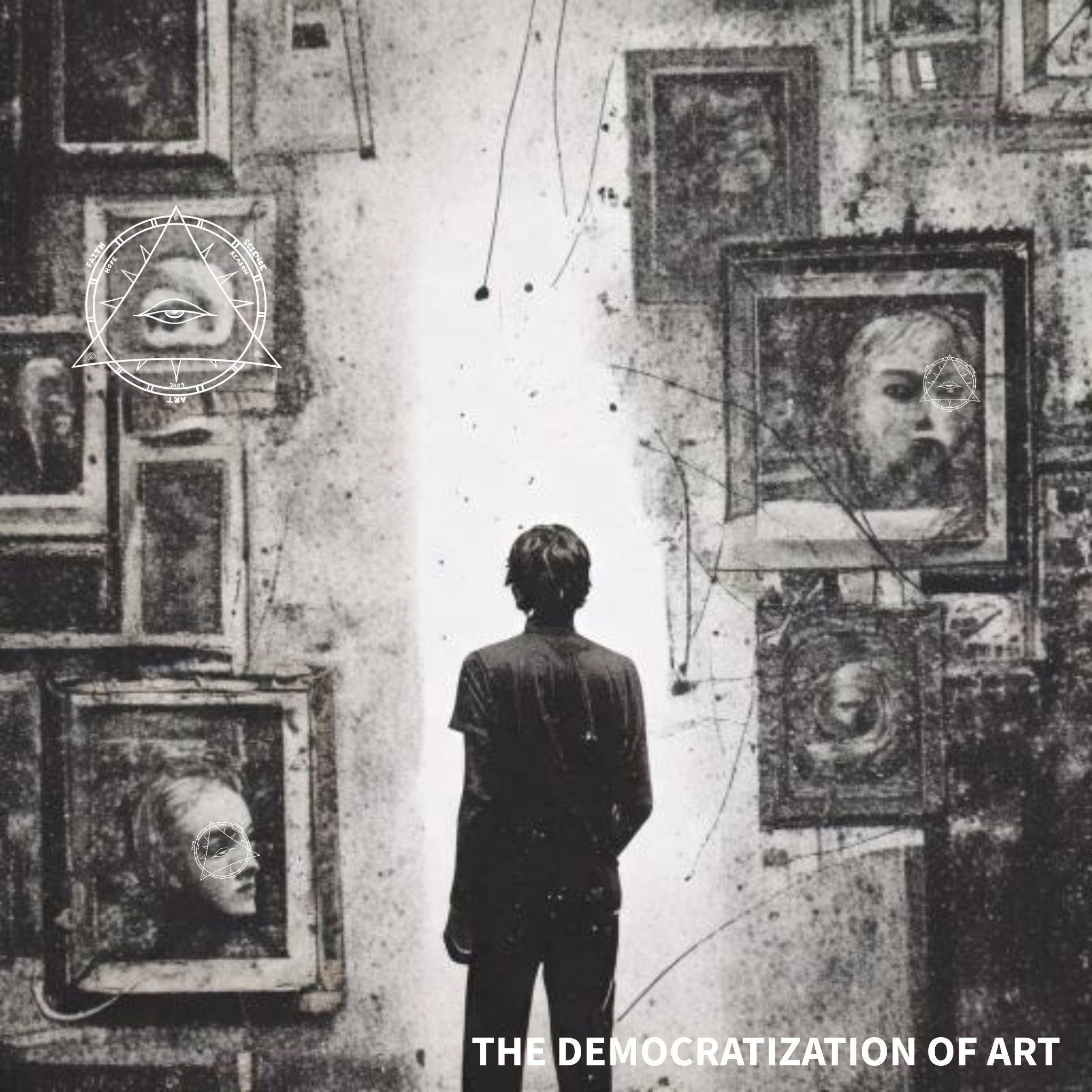
It’s here that we begin to see how the democratization of art can be a double-edged sword. On one hand, there is something profoundly beautiful in the fact that anyone with an internet connection and a few basic tools can express themselves creatively. We’ve seen an explosion of art in all forms—photography, digital painting, music, video—that would have been unimaginable a few decades ago. We’ve torn down many of the barriers that once dictated who could be an artist and who couldn’t. For so long, art was gatekept, locked behind gallery doors, or filtered through critics who decided what was worth seeing. Now, the internet has blown those doors wide open, and everyone is invited inside.
But with this opening of doors, we find ourselves standing in a crowded room...
When so many voices are shouting their truths, and when so many of those truths are accepted uncritically, the criteria for what makes art “good” or “serious” begin to erode. We end up in a paradox where art is both everywhere and nowhere—omnipresent yet diluted. The sheer volume of creative output risks cheapening the act of creation itself, and we begin to lose sight of the craftsmanship that once set certain works apart.
This isn’t to say that only the technically accomplished should be making art or that those without formal training have no place in this new creative world. Far from it. Some of the most inspiring works come from unexpected places, from those who approach art not with a sense of mastery but with a sense of play. But in a world where “likes” and algorithms define worth, the celebration of the mundane has become routine. We scroll through endless streams of visual content, much of it designed to grab our attention for a moment, but rarely to hold it. And in that endless scroll, something crucial is lost—a sense of depth, of meaning that unfolds over time rather than reveals itself instantly.
The act of creating has become inseparable from the act of sharing. Art, once a deeply personal process, is now often public from its inception. We see the sketches, the drafts, the work-in-progress shots—all of it uploaded in real-time, open to commentary before it’s even finished. This shift has changed how many of us perceive our own work. It’s hard to resist the allure of instant feedback, the dopamine rush of recognition, but it can lead to a kind of artistic myopia. In the rush to be seen, to post something that will resonate, we risk mistaking visibility for value. We begin to prioritize the kind of art that gets clicks over the kind that takes time to develop—art that might not speak to everyone but is deeply meaningful to a few.
This is the danger that lurks in the democratization of art: the assumption that simply creating is enough to be called an artist, that the act itself is the end rather than the beginning. When everyone creates, the responsibility to push ourselves beyond the easy output becomes even more critical. The challenge is not just to make, but to strive for something deeper—to cultivate the discipline and rigor that elevate art beyond mere content.
Art is about reclaiming the time to look closely, to listen deeply, and to create thoughtfully, even when the world seems to be racing past. The task isn’t to shut out the multitude of new creators, but to insist that amidst all this creative noise, there can still be a place for silence, for reflection, for art that doesn’t demand to be seen but asks to be understood.
@ CyberArtTime 2024
 CyberArtTime
Leave a comment