
Original Post: June 11, 2025
Though I said to myself,
"See, I have grown and increased in wisdom more than anyone who has ruled over Jerusalem before me; I have experienced much wisdom and knowledge."
Then I applied myself to the understanding of wisdom, and also of madness and folly, but I learned that this, too, is a chasing after the wind (hevel).1
For with much wisdom comes much sorrow; the more knowledge, the more grief.
Ecclesiastes 1:16–18

The Emergence of Awareness
In systems biology emergentism describes how coordinated lower-level activity gives rise to qualitatively new properties. Networks form, neurons fire, and from that dance something profoundly different arises: awareness itself. No single neuron holds a thought, yet the entire system, working together, collectively "thinks". This same logic scales across all life: from individual cells forming tissues, to bodies, and even vast ecosystems. Consciousness isn't some strange outlier; it's a continuous, and the natural outcome of complex organization.

Quantum physics introduces a somewhat mysterious dimension to this idea. Early in the 20th century, physicist John von Neumann offered a provocative bridge between physics and metaphysics. von Neumann developed a quantum mechanical framework mathematically and noticed that the entire system could all be described by the same quantum rules, but this led to an infinite regress. For example: If all are quantum systems, when and how does the wave function2 collapse into a specific outcome?

Alternatively: when and how do infinite possibilities converge into a definitive observable outcome we can mutually observe?
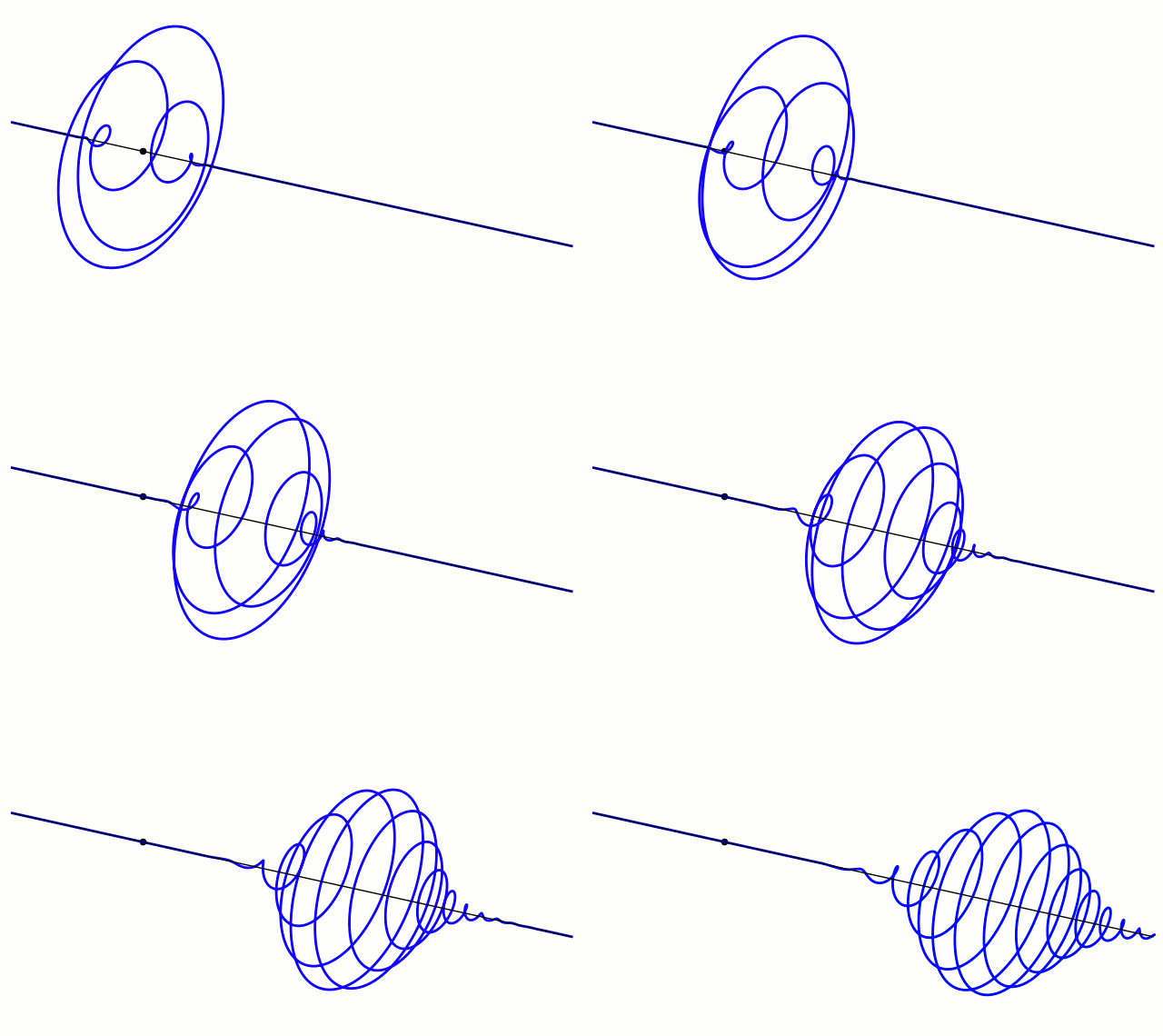
To resolve this, von Neumann posited that the collapse of the wave function couldn’t happen within the purely physical realm. Instead, something outside the quantum chain of events must be involved in interrupting and determining a specific outcome. He proposed that this agent is consciousness. In his model, the observer is not a passive watcher but the boundary where quantum indeterminacy resolves into classical actuality.
Reality does not fully cohere without a mind to perceive it.
This does not mean reality is a dream; rather, it suggests that reality is deeply relational.
It unfolds not independently of us, but actively through our engagement with it.
Philosophically, the implications are potentially significant: if consciousness actively participates in the formation of determinate outcomes, then observation itself has ontological weight.

This notion parallels ancient spiritual and theological insights: Humans are not alien to the cosmos, but its voice. It suggests that our awareness isn't merely a byproduct of atoms randomly colliding, but rather the cosmos itself, coming to behold itself in wonder.
Love. Be confident. Create. Grow.
@ CyberArtTime 2025

- Hevel: Often translated as “vanity,” is more accurately rendered as vapor, mist, or breath. It doesn’t mean meaninglessness; instead, it signifies something transient, elusive, and inherently difficult to grasp. ↩︎
- Wave Function(Ψ): A mathematical description of the quantum state of a physical system, encoding all the information about a particle’s position, momentum, and other physical properties. It represents a superposition of all possible states, with the square of its magnitude, |Ψ(x, t)|², giving the probability density of finding the particle at position x at time t. In one common form for a free particle, the wave function is written as: Ψ(x, t) = A·eⁱ(kx − ωt), where: A is the amplitude; k is the wave number (related to momentum); ω is the angular frequency (related to energy); i is the imaginary unit; x is position; and t is time. This formulation reflects how infinite quantum possibilities evolve over time, converging into a single observable outcome when a measurement is made. ↩︎
 CyberArtTime
Leave a comment