
Originally Posted: December 30, 2024 · Recomposed: August 28, 2026
Paradise often feels distant; an idealized state or destination we aspire to reach. The tradition calls this a fallen world, and locates the distance in the divine order. But what if the separation is ours, born of our own misunderstanding? What if it is a disconnection born of a misdirected desire to possess knowledge; a failure to trust that we already hold everything necessary to experience Paradise here and now?
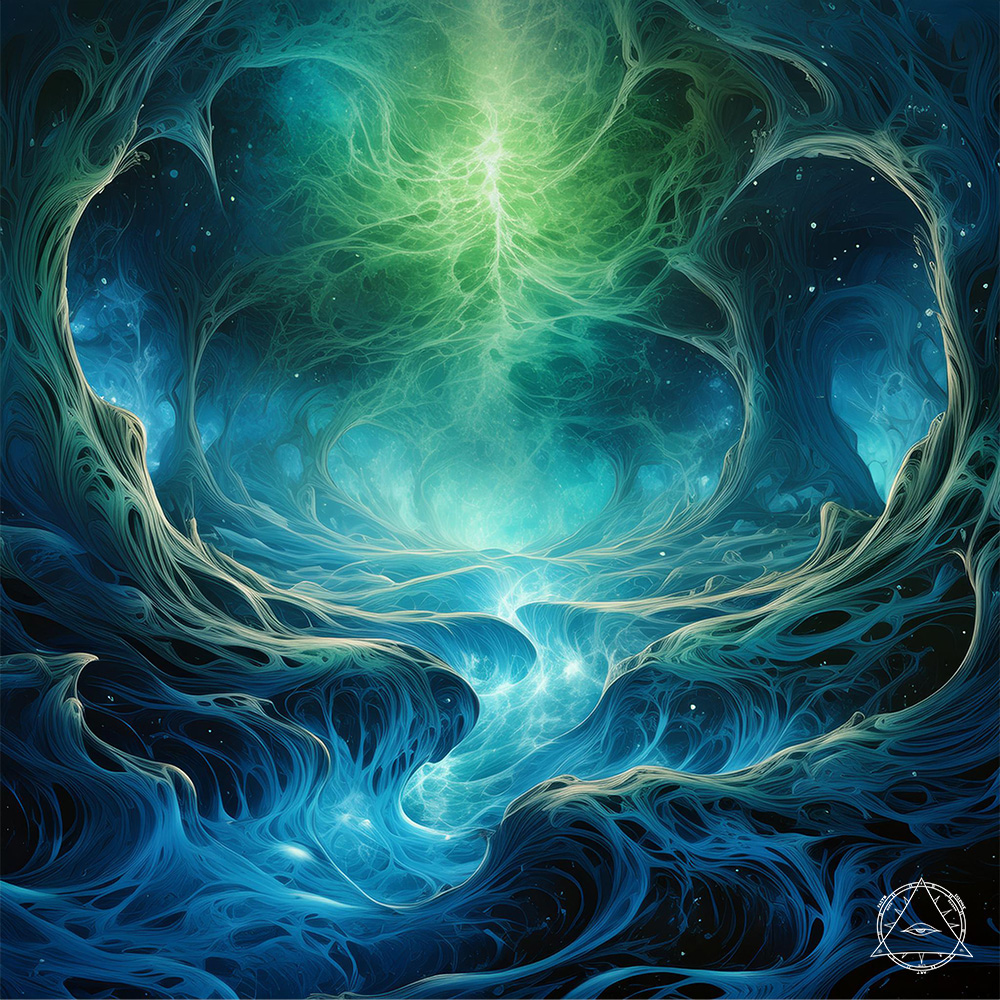
Original sin, then, is a failure of trust; the refusal to believe we already possess everything necessary to experience Paradise in full. That is the story the tree tells.
Sin, most often, is a disorientation; a confusion about God’s grace. It is a misapprehension of our place in the whole; the mistaken belief that we alone are meant to determine our destiny. The belief may seem noble. Yet every thoughtful person must finally acknowledge that we belong with Eternity. We are connected to something larger than ourselves, and we can only be understood in relation to the eternal. Literally.
Eternity, standing beyond time, will prevail, and will hold our memory as favorably as we allow. We are of Eternity; efficiently caused, uniquely existing to conspire in the act of creation, should we choose to participate with The Will.
Perhaps our understanding of participation requires a reorientation. In popular scientific and philosophical exploration there is a growing narrative that consciousness itself shapes objective reality; a view reignited by the popularized hypotheses of twentieth-century physicists like von Neumann1. The perspective draws heavily on quantum mechanics and the notion that the observer affects the observed. However, what if the relationship is one of emergence? What if events give rise to observation, and observation gives rise to conscious awareness?
The concept is old. It aligns with many traditional views. I wish to offer a more pointed version: the immediate and intimate experience of consciousness, the very essence of being alive, is an emergent property of reality. Consciousness is reality continuously formulating itself; a self-reflective expression of the universe’s unfolding, giving rise to the felt experience of existence.
Extend the principle and one might infer that an emergent property of consciousness, particularly in its collective form, is godliness. As consciousness evolves and unites, it increasingly reflects the divine, embodying the creative and harmonizing forces inherent in the fabric of reality itself. This collective consciousness strives toward an ultimate orienting goal, a telos2, that awaits synthesis at the End of Time yet transcends time.
Consider systems biology, where complex, self-organizing systems lead to higher-order functions like consciousness. These processes run on continuous, dynamic relationships within a vast network of interactions. Individual cells organize and communicate to form tissues, organs, and finally a conscious being. On the loose analogy that the cosmos organizes as living systems do, the finely tuned constants that allow for life hint at consciousness as an emergent property of an interconnected reality. This resonates with the theological claim that we are “efficiently caused”3; beings imbued with purpose within a grand, unfolding design. As cells participate in the larger organism, we participate in the unfolding of the cosmos. Our single awareness contributes to a greater whole.
The shift from “we create reality” to “reality creates self-awareness” invites humility and clarity. We are creations, actively shaped by the Universe. We belong to the cosmos; participants in its unfolding, arising from the interplay of its elements. And if observation is as fundamental as spacetime, the two form a dynamic duality, endlessly sustaining and informing one another. Spacetime provides the canvas on which observation unfolds. Observation gives meaning and definition to the expanse of spacetime. A cosmic dance of interdependence, where each partner relies on the other for its existence and its weight.
Yet even this elegant symmetry feels incomplete.
We are left with the burning sensation of “I AM”4, of SELF.
We are left with the undeniable reality of subjective feeling, of longing, and of love, which yearn for something beyond the duality of observer and observed. We are driven by a desire for connection, for creation, for a deeper participation in the unfolding mystery of existence…
We are disconnected from Paradise because we hold it at arm’s length, perceiving it as an ideal awaiting us in some distant future. But what if Paradise is more than a destination? What if it is a reality we can actively help bring forth? Perhaps this is the true meaning of “original sin”: a forgetting of our inherent connection to the divine, and of our power to co-create a world that reflects its beauty and harmony. Knowledge to be nourished, cultivated, and shared.
It is time to reorient our understanding of participation. We are active participants in the unfolding of the universe. Every act of love, every gesture of compassion, every choice to align with the Will of Eternity contributes to the weaving of Paradise.
This is active engagement with the present moment. It is cultivating inner peace. It is transforming suffering into compassion. It is recognizing the interconnectedness of all beings. Paradise is a state of being; a way of living that reflects the divine within us and around us.
Yesterday I was clever, so I wanted to change the world.
Today I am wise, so I am changing myself.
Rumi
@ CyberArtTime 2024
Footnotes
- John von Neumann (1903–1957) was a pioneering mathematician, physicist, and polymath who made significant contributions to quantum mechanics, computing, and systems theory. In the context of quantum mechanics, von Neumann proposed the “Von Neumann-Wigner interpretation,” which suggests that consciousness plays a critical role in the collapse of the quantum wave function. This idea, though not universally accepted, has influenced debates about the relationship between observation, reality, and the role of consciousness in shaping the universe. His work underscores the interplay between theoretical constructs and experiential phenomena, inviting deeper reflection on the nature of knowledge and participation in the cosmos. ↩︎
- Telos (τέλος in Greek) is a philosophical term meaning “end,” “purpose,” or “goal.” It often refers to the inherent purpose or ultimate aim of a thing or process. It is a concept central to Aristotelian philosophy, referring to the inherent purpose or final cause of a thing or process. It suggests that everything in the universe strives towards a specific end or fulfillment. ↩︎
- “Efficiently caused” refers to the Aristotelian concept of causation, where an external agent or force brings about a change or effect. In this context, it suggests that our existence is the result of a purposeful act of creation. This phrase draws from Aristotelian philosophy, which outlines four distinct types of causes: material, formal, efficient, and final. The efficient cause is the agent or force that directly brings about a change or effect. Think of a sculptor shaping clay: the sculptor is the efficient cause of the statue. In this context, “efficiently caused” suggests that our existence is the result of a purposeful act of creation by an external agent or force. It implies that we have been brought into being with a specific intention or purpose. ↩︎
- The biblical name of God provided to Moses in Exodus 3:14, often translated as “I AM THAT I AM,” but its literal meaning is closer to “I will be what I will be.” It signifies God’s existence as being, his eternal and unchanging nature. This resonates with the Jewish mystical concept of “Yesh” (יש), which signifies existence or being. In Kabbalistic thought, “Yesh” represents the manifestation of the divine in the world, the realm of creation and perceptible reality. Therefore, this divine name not only emphasizes God’s eternal nature but also points to his active presence within creation. ↩︎
 CyberArtTime
Leave a comment