
Originally Posted: September 18, 2026
Someone told me recently, with the care of a person handing over something fragile, that they have spatio-temporal synesthesia.1 The months, they explained, are arranged around them in a ring, with “October off to the left and a little behind.”
They wanted me to know.
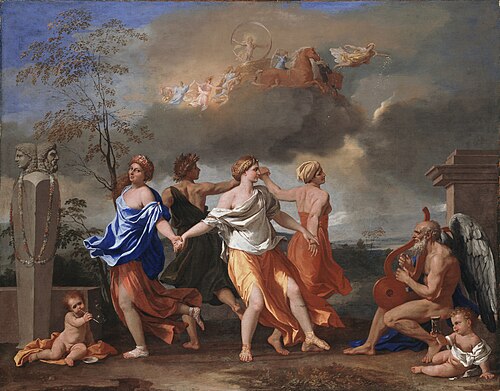
I asked a few questions, and the answers were what you would expect from anyone who thinks in pictures.
They remember faces before names. They sketch when they explain. They find a street by its shape rather than its number. Somewhere in childhood, this visually-oriented mind met a calendar – twelve alien words called months which had no shape at all – and did what it does with everything else: it literally shaped the concept so as to on to it.
It is what a visual thinker builds when handed something abstract, and it works (worked) so well that its owner forgets having built it.
Is that worth a name?
Names help people find each other. But watch what a name does once it is in hand. It turns a habit of mind into a possession, so that “I picture the year this way” becomes “I have A THING.”
And that THING, once owned, begins to want an audience.
…
I’m now tempted to file a case report of my own. Might the following become pathologized in due time?
Olfactory-gustatory synesthesia:3 the subject reports that odors reliably and involuntarily evoke flavor, present since infancy, and resistant to voluntary suppression, with a prevalence of roughly everyone.
or how about….
Lexical-chromatic synesthesia, in which the word “red” involuntarily evokes the concept of red.
one more….
Temporal-mnemonic synesthesia, where the perception of a clock’s hand moving is accompanied by the involuntary conviction that time is passing.
I believe many of us go looking for a label because the label promises to make us rare, and rarity feels like standing. It is a small mystique, cheaply bought.
However, beneath the wish to be rare is usually a plainer ache: the fear of being ordinary, which on inspection is the fear of not being seen.
The wish to be seen is real, and a diagnosis is a poor way to answer it.
When someone hands you their thing, whatever it is – a ring of months, a color for Tuesday, a tune that belongs to a smell – take it the way it was offered.
What they are giving you is a small piece of how they see, and folded inside it is a question: can you see me?
Say yes. Ask where October sits. Let them draw it for you. By the second sentence the label will matter less and the person will matter more.
Common, and still a marvel.
No one is less worth seeing for being one of many.
Love. Be confident. Create. Grow.
@ CyberArtTime 2026

Footnotes
- Spatio-temporal synesthesia (real). Also called sequence-space synesthesia, or “number forms” after Francis Galton’s 1880 description in Nature: a trait in which ordered sequences such as months, weekdays, or numbers are experienced as occupying fixed positions in space around or before the person. Modern studies (Simner, Ward, and colleagues) find the layouts stable over months and able to pull attention toward a month’s “location.” It appears in no diagnostic manual and is classed as a perceptual trait; prevalence estimates run from a few percent to roughly one in five, depending on how the question is asked. ↩︎
- Nicolas Poussin (French, 1594–1665), A Dance to the Music of Time (La Danse de la vie humaine), c. 1634–1636, oil on canvas, 82.5 × 104 cm. The Wallace Collection, London, P108. Public domain. ↩︎
- Olfactory-gustatory synesthesia (invented for this piece). No such diagnosis exists. The description is nonetheless accurate as an account of ordinary flavor: most of what we call taste is smell reaching the nose from the back of the mouth (retronasal olfaction), which is why food goes flat during a head cold. The tongue alone reports sweet, salty, sour, bitter, and savory; everything else in a mouthful is odor. ↩︎
 CyberArtTime
Leave a comment